Copied!
July 27, 2026
Telos Lightspeed: Instant Finality Is Live
5
min read
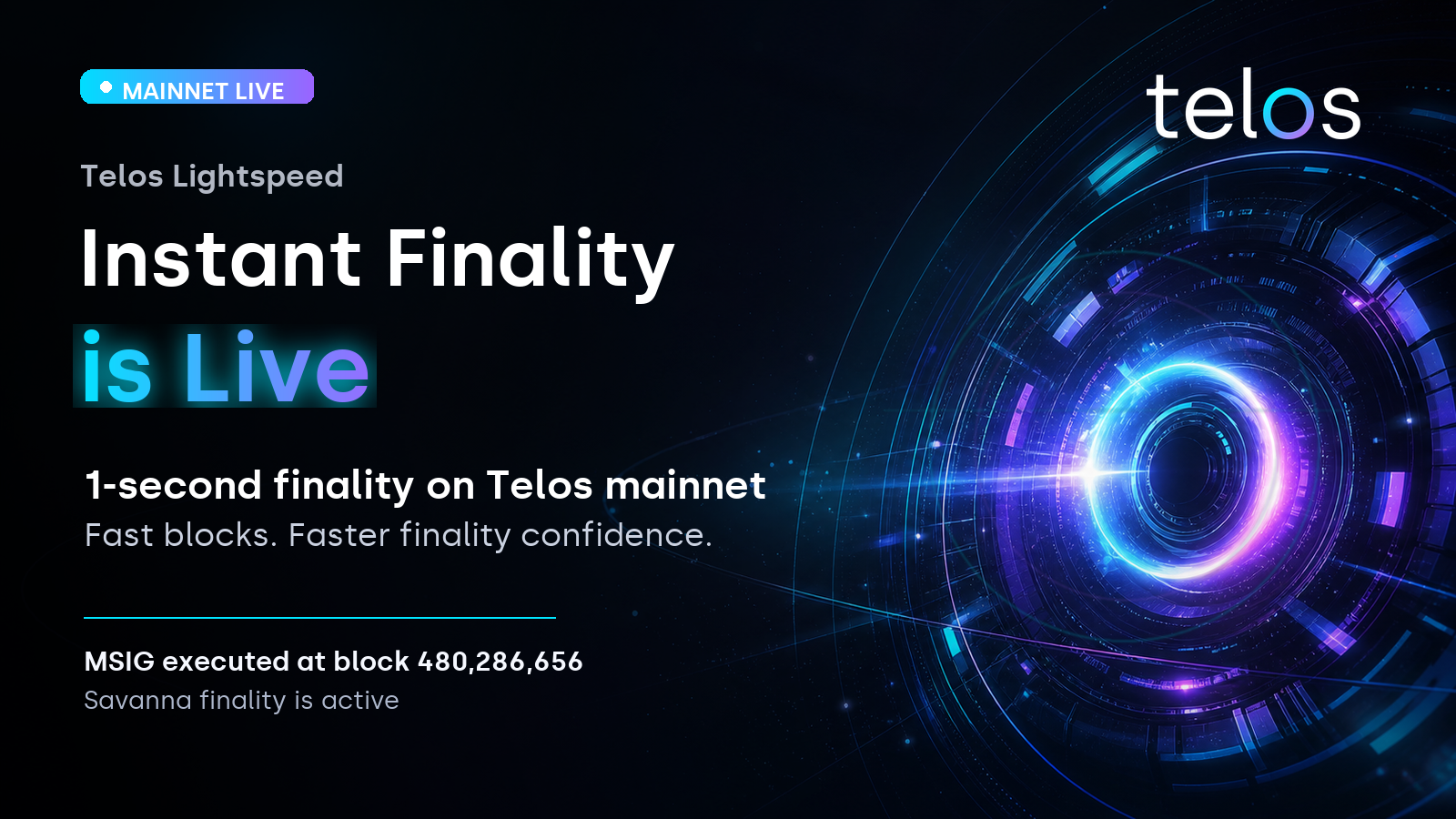
Telos mainnet now has Instant Finality.
On July 27, 2026, the switchtosvnn MSIG executed at block 480,286,656 and became irreversible. Telos mainnet is now running Savanna consensus with 1-second finality, completing the second major milestone in Project Lightspeed.
Telos was already fast. Now settlement can keep up.
For users, that means less waiting around wondering whether something is done. For builders, exchanges, bridges, wallets, DeFi apps, games, indexers and payment flows, it means a clearer point where the app can say complete and actually mean it.
This was not just a switch
Live Layer 1 consensus upgrades are hard.
This was not a marketing label or a parameter tweak. Bringing Instant Finality to Telos mainnet required core software work, system contract changes, BLS finalizer key registration, finalizer activation, and coordination across the block producer network.
The protocol-feature groundwork happened earlier in the rollout. The mainnet consensus transition itself happened on July 27, 2026, when the switchtosvnn MSIG executed and became irreversible.
That is why Instant Finality is part of Project Lightspeed rather than a standalone announcement.
The first major milestone was TelosZero Core, the Telos-maintained core node software foundation. TelosZero Core gave the network a clearer path for operator releases, protocol work, and future upgrades under Telos stewardship.
Instant Finality builds on that foundation.
With Savanna active, Telos mainnet now uses BLS finalizer cryptography to support 1-second finality. Current mainnet readiness data shows SAVANNA active, 21/21 scheduled BP finalizers active, and a live LIB lag of 2 blocks.
Why finality matters
Fast blocks are useful. Finality is what makes speed easier to trust.
Finality is the point where apps and infrastructure can treat a transaction as settled. It affects the practical parts of blockchain UX:
- when a deposit gets credited
- when a bridge message can move
- when a swap can be trusted
- when a wallet can stop showing pending state
- when an indexer can process finalized chain state
That is why 1-second finality matters.
It is not only about saying the network is fast. It is about making Telos speed more usable for things people actually build.
Delayed finality creates a trust gap. The transaction may be included in a block, but the app still has to wait before it can treat that transaction as final. That waiting period may be tolerable for low-value activity. It becomes a much bigger problem for deposits, bridges, DeFi, payments, tokenized assets, games, wallets, and anything where the user expects the app to move in real time.
The longer the finality window, the more awkward the user experience becomes:
- users are left staring at pending states
- wallets and apps need extra confirmation logic
- bridges and exchanges have to be more conservative
- indexers and analytics systems need to handle more uncertainty
- users learn that confirmed may not really mean done yet
That last point is the trust problem. If users cannot tell when a transaction is actually settled, they do not trust the app, even if the underlying network is working as designed.
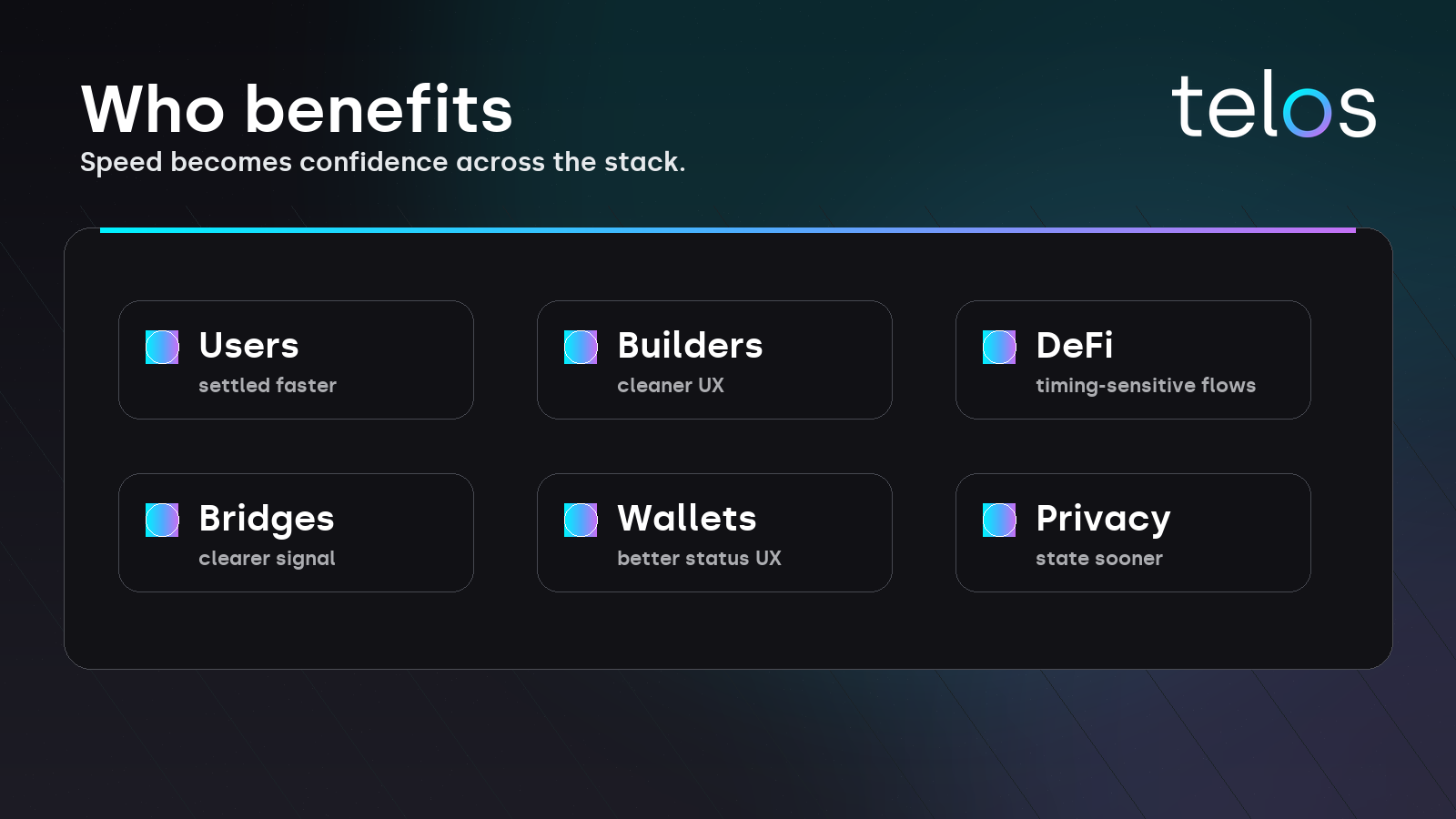
For users, the benefit is straightforward: faster confidence after taking an action.
For builders, it means cleaner product flows. Apps can rely on a stronger settlement signal instead of designing around long waits or fuzzy confirmation states.
For DeFi, it helps with timing-sensitive activity like swaps, routing, liquidations and settlement.
For bridges and cross-chain systems, it gives a clearer finality signal for messages and asset movement.
For exchanges and custodians, it provides stronger confirmation rails for deposits and withdrawals.
For wallets, it creates a better path to transaction status UX that feels less awkward and more immediate.
For indexers and analytics teams, it gives a more reliable point around finalized state.
None of that is glamorous. That is the point. Finality is infrastructure. When it gets better, the whole network gets easier to build on.
Why this matters for privacy
Instant Finality also matters for the privacy side of the Telos roadmap.
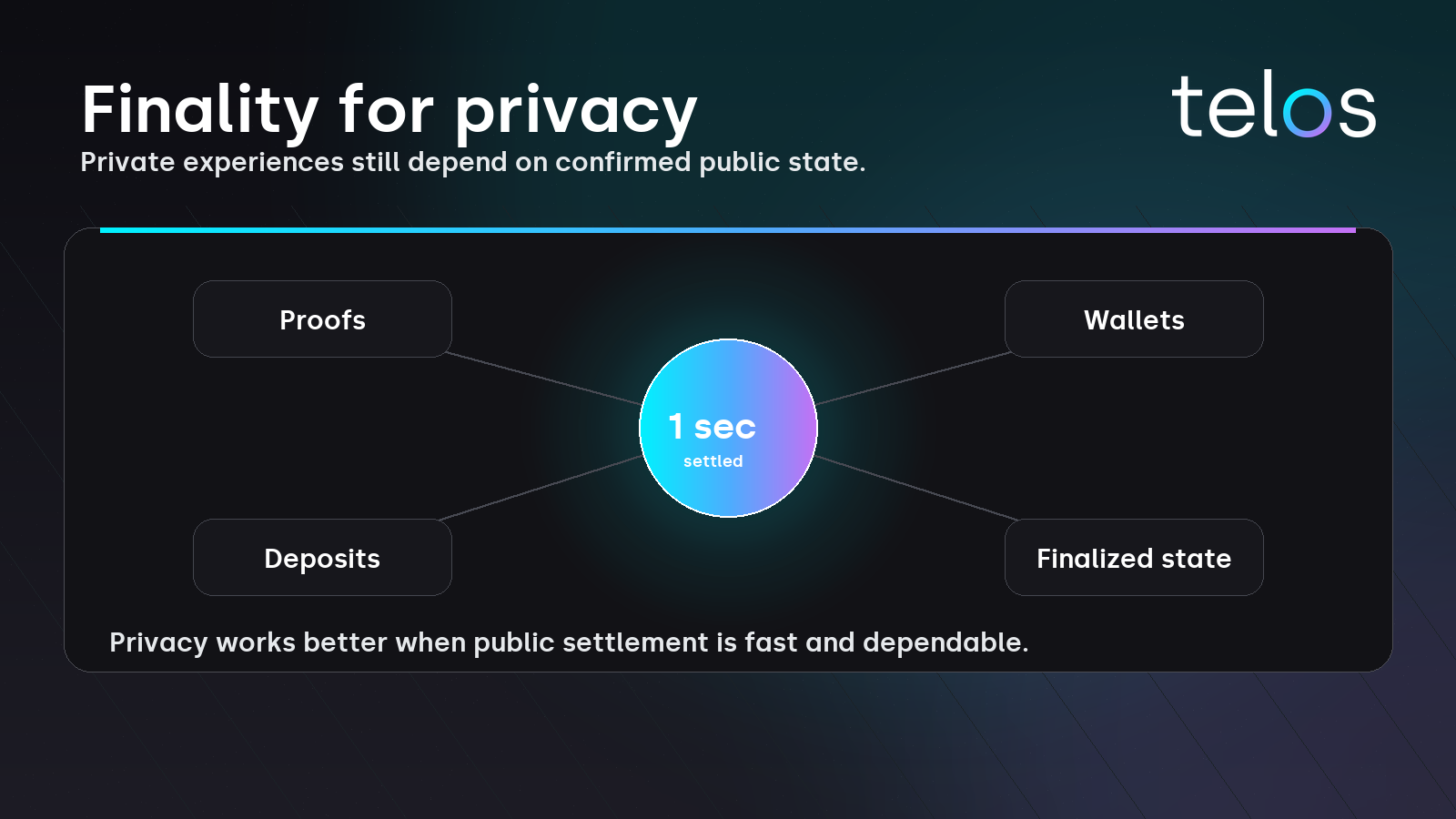
Privacy technology does not live in isolation. Shielded transfers, proof flows, deposits, withdrawals, private balances, bridge movement and confidential app UX all still depend on public-chain settlement at some point.
If the public settlement layer is slow or uncertain, privacy UX suffers. Users wait longer. Apps need more fallback logic. Bridges and wallets have to make conservative assumptions.
With 1-second finality live, Telos has a better base for privacy-enabled applications. Private user experiences can move faster because the public-chain actions around them can settle faster.
That is important for Telos Privacy, and it is important for future confidential apps that need more than private computation. They need fast, reliable settlement underneath.
Telos is taking more control of its stack
There is a bigger story here than finality alone.
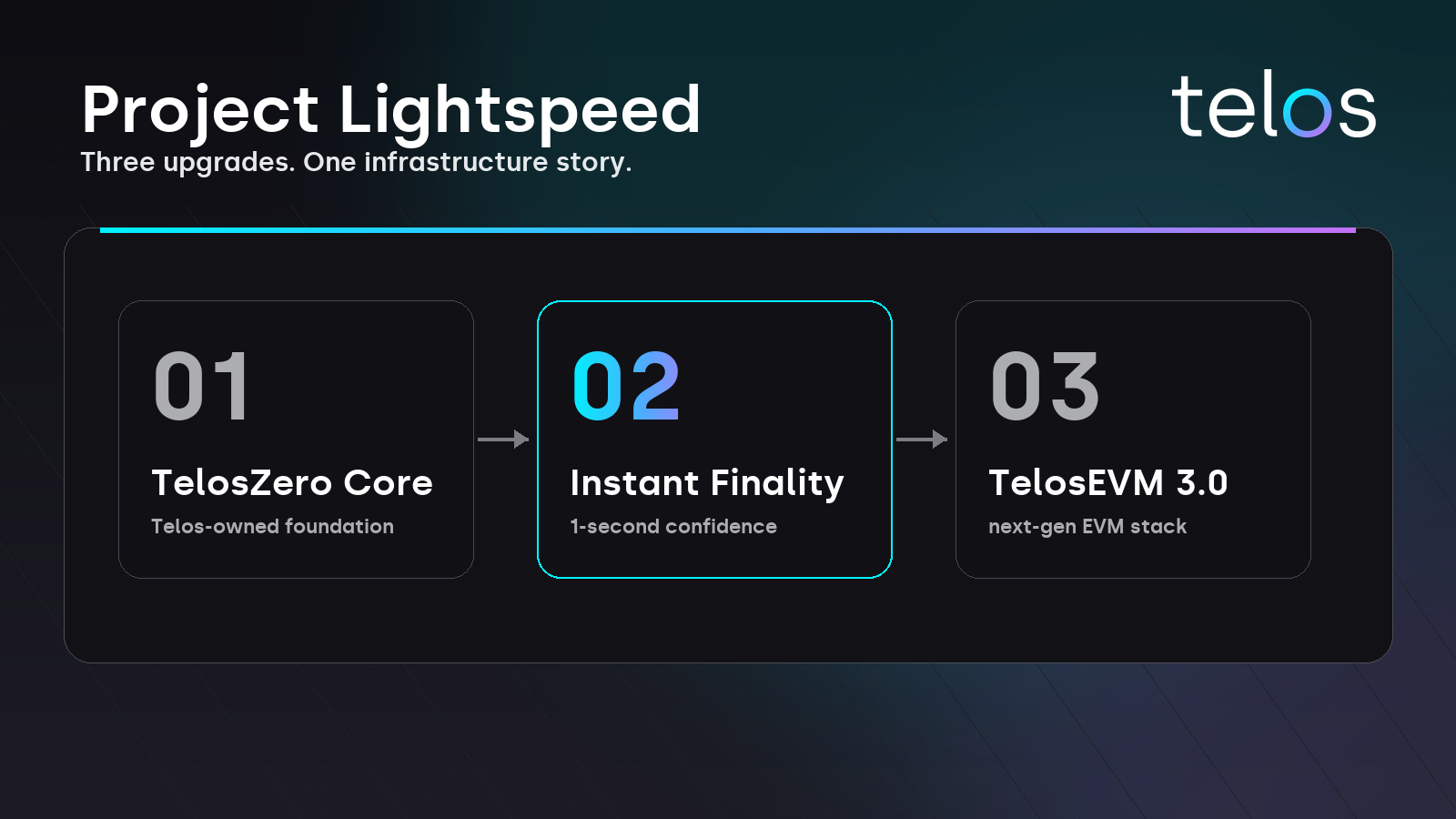
Project Lightspeed is about Telos taking more control of the infrastructure it depends on:
- TelosZero Core: Telos-maintained core node software.
- Instant Finality: Savanna finalizer consensus on mainnet.
- TelosEVM 3.0: the new EVM stack with telos-reth v2.
That sequence matters.
TelosZero Core gives operators a Telos-owned foundation. Instant Finality gives transactions a faster point of settlement. TelosEVM 3.0 brings the next part of the story to Solidity developers, RPC operators and the broader EVM ecosystem.
This is how Telos controls its own destiny: core software, consensus upgrades, EVM execution, privacy-ready settlement, and the ability to keep adapting as the industry changes.
Web3 infrastructure is not standing still. The next decade will bring harder requirements around privacy, cryptography, interoperability, security, performance and eventually quantum-resistant infrastructure.
Networks that cannot upgrade will get stuck.
Telos is showing that it can move.
What went live
The key activation facts:
- Instant Finality is live on Telos mainnet.
- Telos switched to Savanna consensus on July 27, 2026.
- The
switchtosvnnMSIG executed in block480,286,656and is now irreversible. - The transaction ID is
7700713b654f03835856d0de3e32a3a7825d96008ba5fd6f86a05bb25c5f5244. - Savanna finalizer policy generation 1 is active with a threshold of 15.
- All 21 scheduled BP finalizers are active.
- Live mainnet data shows LIB lag at 2 blocks, down from approximately 330 blocks before the transition.
- Telos mainnet public RPC reports Spring/TelosZero-compatible
v1.2.2-lateblockfix.
Post-transition checks covered two complete producer cycles. All 21 block producers produced exactly 24 blocks, with no missed slots or timestamp gaps detected. Native RPC endpoints remained synchronized, and EVM RPC continued operating normally.
The readiness checker may still show review items around public BP API visibility, public P2P visibility or operator-private checks. Those are not the same thing as Savanna being inactive. The consensus transition is complete.
Project Lightspeed continues
Fast blocks got Telos here. 1-second finality opens the next chapter.
Instant Finality gives Telos a better base for apps that need speed and confidence at the same time. It also puts the network in a stronger position for privacy, bridges, DeFi, games, payments, wallets, exchanges and high-volume user experiences.
Project Lightspeed now has two major pieces live: TelosZero Core and Instant Finality.
Next comes TelosEVM 3.0 with telos-reth v2.
Resources
Disclaimer
The content provided in this article is for informational purposes only and should not be construed as financial or investment advice. Always conduct your own research and consult with a professional before making any financial decisions. Cryptocurrency investments along with other asset classes can be volatile and can result in potential losses. Always use caution, practice due diligence, and never invest capital you cannot afford to lose. Remember to always maintain the security of your accounts, use strong passwords, enable two-factor authentication, and be wary of phishing attempts. Stay safe and invest responsibly.
About The Telos Foundation
Telos is a decentralized blockchain ecosystem that includes Telos EVM, which is tested as the fastest Ethereum Virtual Machine globally, and its high-speed consensus layer, Telos Zero. With its continued focus on helping push forward the global adoption of Zero Knowledge technology, Telos is also currently developing a hardware-accelerated Ethereum Layer 2 network powered by SNARKtor, with the goal of enhancing privacy and scalability for global use cases at scale. Telos is overseen by The Telos Foundation, an ownerless foundation dedicated to advancing the Telos blockchain network and its community.


Telos Alpha, straight to your inbox
Thank you! Your submission has been received!
Oops! Something went wrong while submitting the form.
Community channels